My Research
All in all, my research is oriented toward improving the experience of life. What else should it be oriented toward?
Practically speaking, this curiosity and intention must manifest itself with a bit more structure. This structure, to me, is as follows:
“Neuronal structure sensitivity to vibration makes calculated reorganization of thought process possible via exposure to mathematically cultivated sound.”
I call this endeavor the Sound Secret.
Sound, not only its experience through audition, but through its penetrative nature in conjunction with the roots of our neurobiology, makes it so that the architecture of our brains can be shaped with sound. This means it is theoretically possible to create a ‘sound bath’ that grants an individual nirvana.
Why has it not been done before?
Lots and lots of data are needed. With around 100-150 trillion unique synaptic connections in every single brain, you might have better luck getting struck by lightning the very moment you win the lottery than just stumbling across a one-size-fits-all sound bath.
Not all hope is lost!
- The impact of individual neurons on consciousness is nearly entirely characterized by rate of firing (0.001 - 1000 times per second), and the greater the synchronization, the greater the conscious experience of bliss.
- Synchronization of neural tissue can be measured via EEG recording
- Altogether, this means we have a general roadmap of what to look for; what we must do now is find out what it takes to get neurons to fire with enhanced synchronicity.
1 possible way:
- Controlled exposure to sound is executed in reality with Participant X
- EEG recording data is stored as Sound emitted paired with the wave produced at point T in time
- With enough data, consistencies will be found to find statistically significant correlations between sound wave exposed to and brain wave response
- What is achieved: concrete quantification of biological response to sound exposure
- Within a virtual environment, a neural system is modeled with anatomically representative neuronal structure and neuronal characteristics
- With biological response of Participant X known, simulations of the virtual environment can be run assigning randomized properties to individual neurons within virtual environment, until…
- You eventually build an identical virtual representation of Participant X’s brain
- You can run endless tests of virtual exposure to vibration until desired synchronization is reached —
Compressed Recap:
- Use EEG to determine causal response of brain when exposed to sound (Learn sound P → Brain waves Q)
- Build virtual environment to reflect anatomical brain structure
- Run simulations of the virtual brain’s exposure to sound until the virtual model becomes an accurate representation of a real human’s (Run simulations until virtual sound P → virtual brain waves Q)
- Run simulations on an accurate representation until harmony is achieved (Run simulations until virtual sound X → virtual brain waves Z)
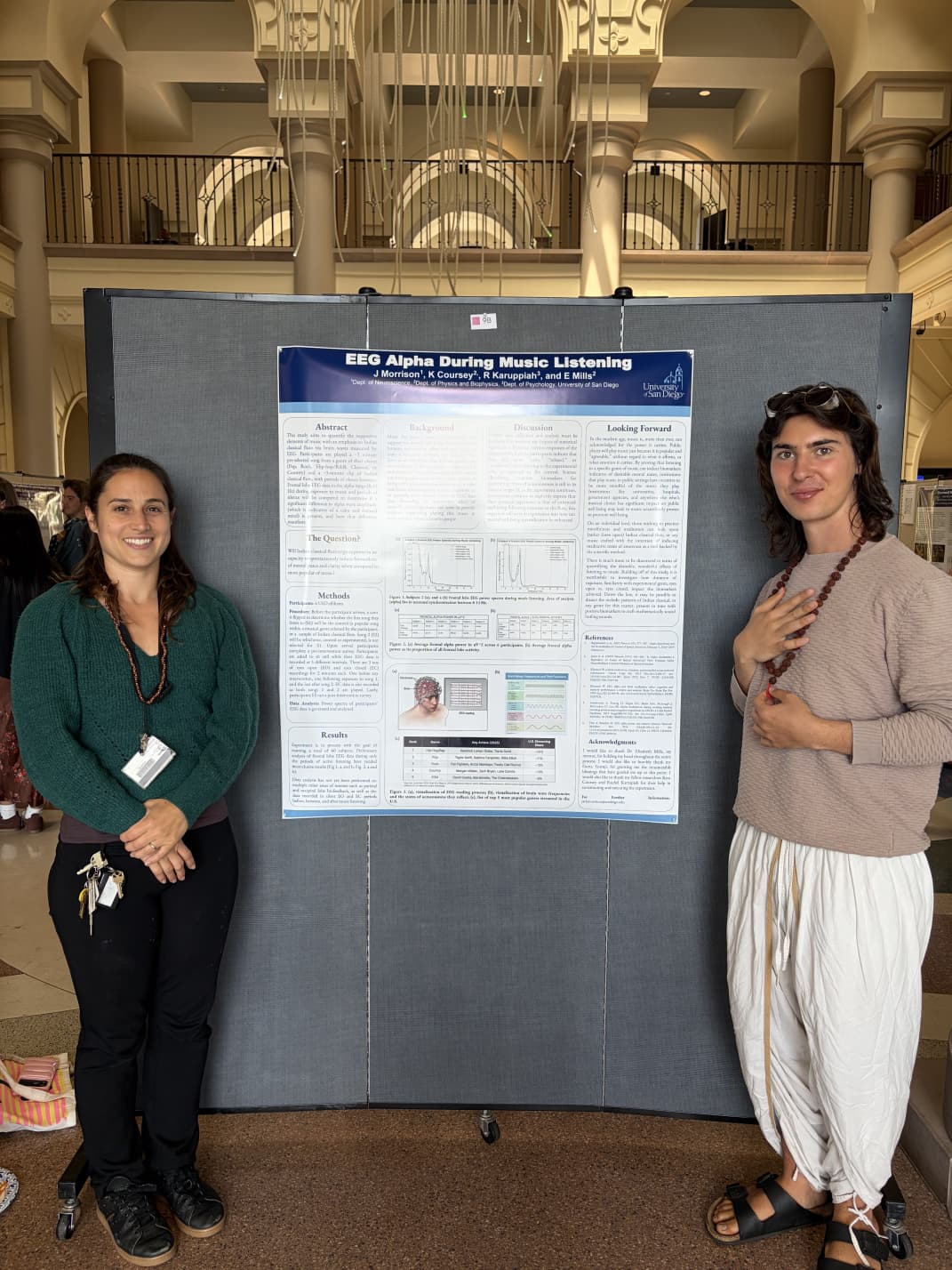
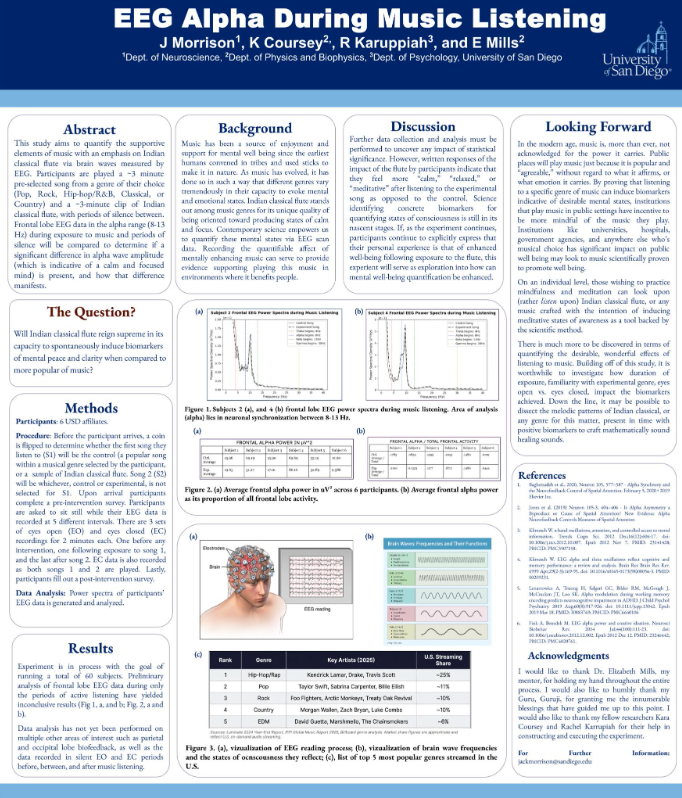
I have been blessed to pursue my curiosities in great ways. Especially through my work with the University of San Diego’s biophysics department under the mentorship of Dr. Elizabeth Mills. Currently in progress is an experiment centered around measuring EEG feedback in response to popular music versus Indian classical flute and shamanic drumming. Focal to the sound secret, this will provide a library of EEG data with which preliminary data analysis of audition and biofeedback response can be conducted.
If you are a fellow scientist and you see somewhere I’m dead wrong, somewhere I’m spot on, and you have studied in this domain, even if this research interests you and you would like to be involved, please reach out!